20M users added.
$6.9M saved.
50,000 people a day tried to open a Mara account, with a $1M World Cup push about to double that. A 27-step gauntlet wasted most of it. Paid to get them, paid to lose them.
funnel analysis
Seven leaks. KYC alone cost 700,000 users a month.
- Signup asked for everything up front: email and SMS verification, Country three times, personal details, a PIN and biometrics.
- Every added step raised drop-off, before users had even tried the product.
- KYC lost more users than every other step combined.
business case
KYC billed per attempt: $400,000 a month, losses included.
- The KYC provider billed per API call, regardless of outcome.
- The nested KYC flow compounded an already heavy signup, so many users quit mid-check.
- A user lost at KYC was paid for twice: once to acquire them, and once on the check that lost them.

Verify Your Identity
Identity verification helps us keep the Mara Tribe safe.
Home Address
Country
BVN number
Dial *565# to get your BVN
Please provide your BVN, Mara uses your BVN to verify your address automatically
Home Address
Country
BVN number
Dial *565# to get your BVN
Please provide your BVN, Mara uses your BVN to verify your address automatically

Your address has been automatically verified
Next step is to verify your identity which will be done using the BVN you provided.

Time to take a selfie
Keep a straight face
👨🏿
Make sure your eyes are visible
👁️

Put your face in the circle
Make sure your face is visible

Your Selfie
Ensure you have a straight face
Make sure your eyes are visible

We are verifying your identity
We will notify you when the verification process is complete.
Verify Your Identity
Identity verification helps us keep the Mara Tribe safe.
Home Address
Country
BVN number
Dial *565# to get your BVN
Please provide your BVN, Mara uses your BVN to verify your address automatically
Home Address
Country
BVN number
Dial *565# to get your BVN
Please provide your BVN, Mara uses your BVN to verify your address automatically
Your address has been automatically verified
Next step is to verify your identity which will be done using the BVN you provided.
Time to take a selfie
Keep a straight face
👨🏿
Make sure your eyes are visible
👁️
Put your face in the circle
Make sure your face is visible
Your Selfie
Ensure you have a straight face
Make sure your eyes are visible
We are verifying your identity
We will notify you when the verification process is complete.
KYC
KYC moved to the first transaction. Useful checks hit 98%.
- Only 15% of onboarded users ever transacted, so 85% of every KYC bill bought nothing.
- AML rules require verification before money moves, not at signup: the check could legally wait.
- At transaction time users have clear intent and a real reward: useful checks rose from 15% to 98%.


To Add Funds you must complete a P2P Deposit. Once you confirm the desired amount we’ll generate the details of that transfer for you to follow.


To add funds, you need to verify your account first. It's a one-time check that unlocks all future transactions.


Your document’s review will be processed by a specialised third-party partner automation.
To Add Funds you must complete a P2P Deposit. Once you confirm the desired amount we’ll generate the details of that transfer for you to follow.

Your account has been successfully verified.
To Add Funds you must complete a P2P Deposit. Once you confirm the desired amount we’ll generate the details of that transfer for you to follow.
Please perform the transaction with your bank app before you tap on the Finish button to successfully complete the payment.


Once the operation is complete, we’ll credit the funds onto your account. You can refer back to this message at any point.
The funds should be with you shortly.
Please perform the transaction with your bank app before you tap on the Finish button to successfully complete the payment.
Once the operation is complete, we’ll credit the funds onto your account. You can refer back to this message at any point.
onboarding
Six more leaks cut. Onboarding ended at three actions.
- Email became the single identifier and channel, cutting the $100k a month SMS verification bill.
- Personal details collapsed into one step with Country included; biometrics moved to first login.
- Acquisition rose to 2.1M new users a month.
3:50
By entering and tapping sign-up you agree to the Terms & Privacy Policy


Enter your email
akin.musa@gmail.com

Check your email
We’ve sent an email to akin.musa@gmail.com.
Sign up with the magic link. It expires in 15 minutes!
Let’s get some basic info.


Make sure your name matches your Government Issued Documents


3:50


Your account has been created
Welcome to Mara!
Please verify your identity for a seamless experience.
3:50
Create PIN
Protect your account with a PIN
1
2
3
4
5
6
7
8
9
0
3:50
Confirm PIN
Just to be sure
1
2
3
4
5
6
7
8
9
0
3:50
Total Balance:
₦60.00
₦5.00
Mara Token
$MARA
₦800
800 $MARA
Nigerian Naira
NGN
₦500.00
₦500
Nigerian Naira
NGN
₦418,000,000
₦418,000,000
Bitcoin
BTC
₦140,00
0,000011 BTC
Tether
USDT
₦100.00
0.24 USDT
3:50
Home
Market
Academy
Profile
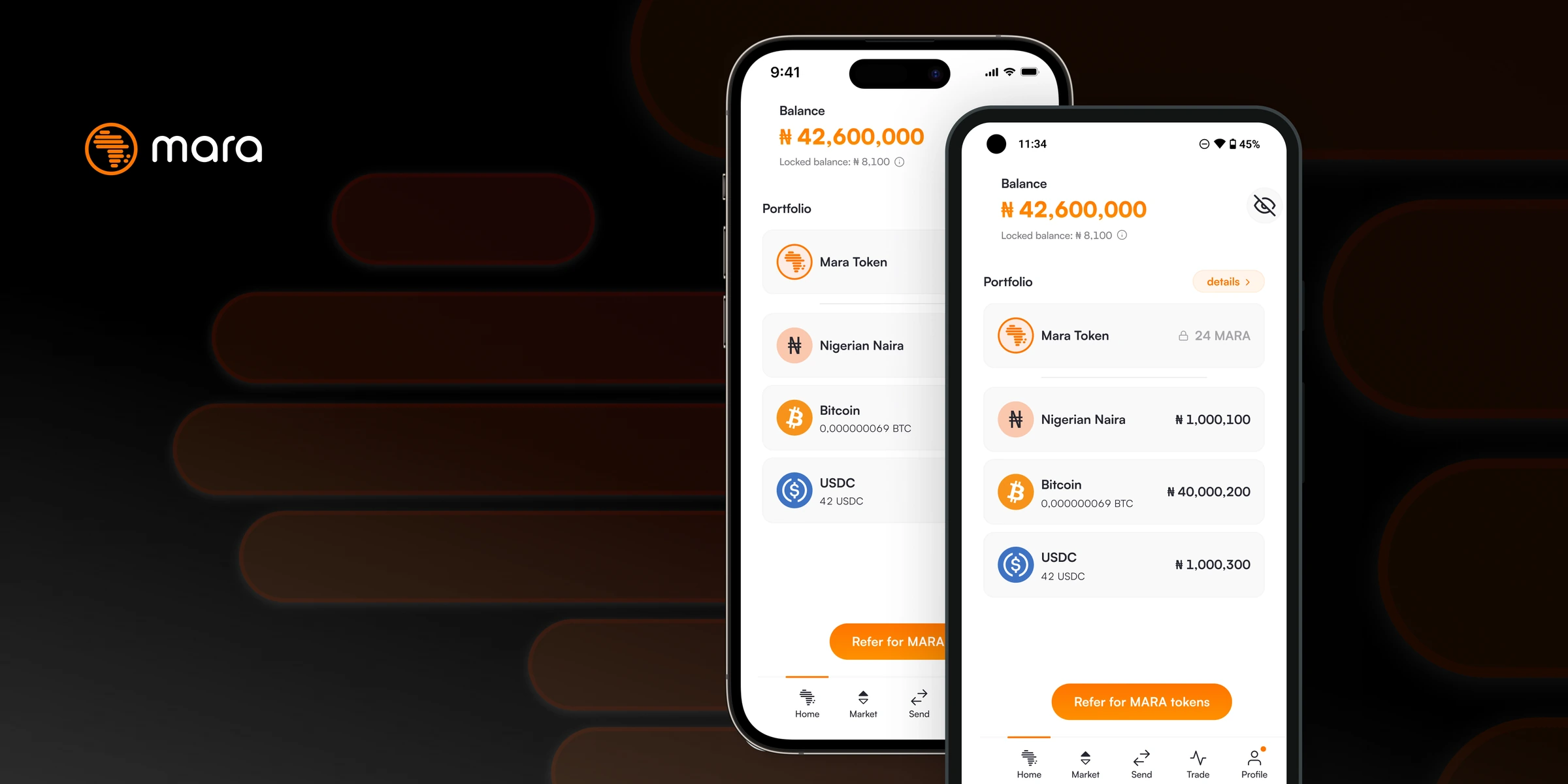
That closed the leak. 2.1M new users a month, onboarding in three actions, KYC only when money moved. But signups were never the goal. A wallet earns nothing while an account sits empty, and most accounts sat empty. The money itself, sending, depositing, trading, still ran through a maze. Fixing that meant every flow in the app.
audit
The market ran to crypto. The app couldn’t keep up.
- The naira lost 70% of its value, and Nigerians moved close to $60B into crypto as a store of value.
- Onboarding was fixed, but still only 15% of the users it delivered ever traded.
- The app was the blocker: a home screen split by secondary navigation, and a Send flow hiding its main action behind the keyboard.


messy home


Hard send
design system
One rhythm, every flow: action, preview, commit, outcome.
- Fixing only transactions would move the leak to Deposits, then Withdrawals, then Send.
- Every action in the app was mapped to the same four steps.
- One pattern made every flow familiar on first use.


impact
20M users and $6.9M a year, from holding structure, not fixing flows.
- $5.7M a year saved on KYC, $1.2M on SMS: $6.9M in total, at the new user volume.
- Each step of the old flow was defensible in isolation; together they broke the product.
- Someone had to define that system and hold it. That was me.